Because a pastor’s opportunity to opt out of Social Security is so unique, many Social Security employees don’t understand the law surrounding it. Unfortunately, this results in pastors being denied benefits that are rightfully theirs. This is what you can do to appeal the decision if it happens to you.
How the One Big Beautiful Bill Act Affects Pastors
On July 4, President Trump signed into law the One Big Beautiful Bill Act (OBBBA). It’s an 870-page piece of legislation that contains some things that are relevant to your life, many things that aren’t, and a lot of language that would go right over your head.
I have not read the bill, nor do I intend to. As a financial planner, I know who I trust in my industry, and some of them are happy to read long legislation and parse it out for the rest of us. I thank God for those people, and this blog post would not have been possible without them.
This article will provide a summary of the elements of the OBBBA that are likely to be the most relevant to you. With each aspect of the bill, there are caveats, nuances, and many details that I am leaving out. My goal here is to give you enough information to know if you need to do further research on any of these topics. For each of the things listed below, there are limitations, restrictions, and other rules that you should seek out if they pertain to you. Many of the provisions listed below are only available to taxpayers within a certain income range, and a number of them are only available between 2025-2028.
Tax Terminology to Know: Credit vs. Deduction
Before I get into the OBBBA, I want to review the difference between a tax credit and a tax deduction because the two terms are often confused. A tax credit lowers your actual tax bill. A tax deduction lowers your taxable income, which in turn lowers your tax bill.
To illustrate this, let’s say you have $100,000 of income taxed at a flat 10% (God’s tithe system is so much simpler than the American tax code!), resulting in $10,000 owed in taxes. If you were to receive a $2,000 tax credit, then you would only owe $8,000 in taxes ($10,000 – $2,000 = $8,000). If you were to receive a $2,000 tax deduction, then your taxable income would be $98,000 ($100,000 – $2,000 = $98,000), so your taxes owed would be $9,800 ($98,000 x 10% = $9,800). As you can see, tax credits are worth much more than tax deductions.
Things that are Not Changing
Now let’s get into the OBBBA itself. Back in 2017, the Tax Cuts & Jobs Act (TCJA)was passed, which made major changes to the US Tax Code. In order to keep costs within government-mandated limits, a number of the major changes were temporary. The OBBBA makes many of those changes permanent. Here is a list of things that were scheduled to go away at the end of the year but are now permanent:
Tax Brackets
The TCJA changed all of the tax brackets, and they are now going to stay that way. What you’ve seen for the past seven years is going to continue, though there will be a small inflation bump for the ranges.
No Personal Exemptions
If you remember doing your taxes before 2017, you may recall personal exemptions, which lowered your taxable income based on the number of individuals in your household. Many states still have personal exemptions for their state income taxes. The Tax Cuts & Jobs Act took those away, and now it’s official that they are not coming back for federal taxes.
Qualified Business Income Deduction
Something brand new with the TCJA was the Qualified Business Income (QBI) deduction. That is now going to stick around long term, and they also increased the income limits on the deduction. As a pastor, you may not have a small business that this would apply to, but if people pay you directly for things like officiating weddings, then you are eligible to claim this deduction on that income. This article explains it.
Employer Student Loan Payments
The TCJA also allowed employers to help their employees pay off their student loans tax-free. Employers will continue to be able to pay $5,250 (now indexed for inflation) towards their employees’ student loans, and it is not taxable income to the employee.
I probably should have made a bigger deal about this because it can help a lot of pastors. If you have student loans, ask your church to put some of your compensation towards them. If you were going to make the payment anyway, this is a great way to save on taxes. If you are in the 12% tax bracket and paying 15% SECA taxes, then your employer would have to pay you $7,192 for you to have $5,250 left to put towards your student loans after taxes.
Standard Deduction
The standard deduction was about doubled under the TCJA, and luckily, it’s not going back down again. Instead, it’s getting a little bump even beyond the inflation adjustment.
Things that Are Changing
While the OBBBA keeps a number of things the same that were scheduled to change, it also does the opposite, making a number of changes to existing tax code provisions and even introducing brand new things. Here they are:
Child Tax Credit
Your kids are now worth $200 more each, and that will go up with inflation. I hope that gives someone here a little more patience with their little monsters at bedtime tonight. The Child Tax Credit has been raised to $2,200 and will now increase with inflation. Speaking of the Child Tax Credit, I would like to remind you that your clergy housing allowance can actually be detrimental and limit your Child Tax Credit if you aren’t careful. You can read about that here.
Adoption Credit
In a win for adoptive parents, $5,000 of the adoption credit is now refundable. That means that not only can the credit eliminate your tax bill, but you can also get a check for up to $5,000 for it.
State & Local Tax Deduction
If you saw any news about the OBBBA before it passed, you probably read about the fights over the State And Local Tax (SALT) deduction. When you itemize deductions on Schedule A, you can include any state and local taxes that you paid. The TCJA limited that to $10,000, which was a huge blow to people in high-tax states. The OBBBA raises the limit to $40,000—but only for four years (2025-2028) and only for people with Adjusted Gross Income (AGI) under $600,000 (the phase out begins at $500,000). Come 2029, if those in power at the time don’t change anything, the limit will drop back to $10,000 and then increase by 1% each year.
Private Mortgage Insurance Premium Deduction
After several years of not being able to, you can now deduct your Private Mortgage Insurance (PMI) premiums on Schedule A again. It is treated as qualified mortgage interest and subject to AGI and other limitations.
Charitable Giving
The OBBBA makes some changes to charitable deductions that help those who claim the standard deduction and harm those who itemize on Schedule A. Except for a brief time during the pandemic, the only way to receive a tax benefit for your charitable giving was by itemizing your deductions, which the vast majority of Americans do not do. Now, married couples will be able to deduct up to $2,000 of charitable contributions, and singles will be able to deduct $1,000, on top of the standard deduction. This change goes into effect for the 2026 tax year and will likely benefit many of you reading this. If you’re married in the 12% tax bracket and give at least $2,000, this provision will be worth $240 for you. In the 22% tax bracket, it’s worth $440. While this deduction will lower your taxes, it does not lower your AGI.
For those who itemize deductions on Schedule A, there is now a 0.5% AGI floor for charitable contributions. It works much like the floor for deducting medical expenses, but at least it’s much lower. What it means is that for someone with $100,000 of income, you will receive no tax benefit from the first $500 of charitable giving that you do.
Senior Deduction
One of the big campaign promises we heard was to stop taxing Social Security. While a recent email that many of us received from the Social Security Administration might lead you to believe that it is included in the OBBBA, it is not. There is no provision directly related to Social Security.
That doesn’t mean that seniors were forgotten, though. Instead of something tied directly to Social Security, taxpayers age 65 and older were given an additional $6,000 tax deduction. This is only good for the next four years (2025-2028), and it starts to phase out for married couples with over $150,000 of income and singles with over $75,000 of income.
It is actually a good thing for pastors that the provision isn’t tied directly to Social Security, since some of you opted out. The way it is structured, it applies to any type of income, so those who do not receive Social Security income will still benefit.
While it isn’t exactly what was promised on the campaign trail, it still moves in that direction. It is estimated that the percentage of Social Security benefit recipients who will not have to pay taxes on their benefits will increase from about 66% to about 90% (so the Social Security Administration’s email isn’t false, just misleading).
Auto Loan Interest Deduction
There is a new deduction for auto loan interest. It applies to loans taken out between 2025 and 2028 for new, personal vehicles whose final assembly was in the United States. The maximum deduction is $10,000, and it starts to phase out when your Modified Adjusted Gross Income (MAGI) reaches $200,000 for married couples or $100,000 for singles. As you might guess, there are a lot of little details related to what actually qualifies for this, so read the fine print if you’re thinking of taking advantage of it.
And if you’re thinking of taking advantage of it, please think twice. This is not an excuse to go out and finance and brand new car unless you were already planning to do so. You do not get ahead financially by paying $100 in interest to save $12 in taxes. Please remember to make your financial decisions based on your budget, your needs, and your values, not tax opportunities. Tax planning is supposed to be the frosting, not the cupcake.
No Tax on Tips
This will probably not affect pastors unless you’re bivocational. There is a new income tax deduction of up to $25,000 for tip income. Don’t spend too much time plotting how to have your congregants pay you in tips, though, because the IRS is planning to publish a list of qualified occupations in the coming months, and I’d be surprised to see clergy listed (though I learned in 2020 that anything is possible!).
No Tax on Overtime
Likewise, there is a new income tax deduction for up to $25,000 ($12,500 for singles) of overtime income. This likely will not affect your ministerial income and is only available for 2025 through 2028.
Small Business Owners
There are a number of provisions related to small businesses that I will not discuss here. If you are a small business owner, you will want to look into them.
Trump Account
There is a new investment account for minors, nicknamed the Trump Account. Parents can contribute up to $5,000 per year to these accounts, and employers can contribute up to $2,500 for their employees’ kids and have it excluded from the parents’ income. Contributions can only be made before the child turns 18, and funds can only be withdrawn after the child turns 18. There are restrictions on when and for what funds can be withdrawn and how withdrawals are taxed.
For children born between January 1, 2025, and December 31, 2028, the US Treasury will put $1,000 into the account as soon as it is opened. The child and at least one parent must be a US citizen with a Social Security number. This is free money, so I would encourage everyone with a child who qualifies to take advantage of it.
The rules and benefits of these accounts are enough to justify their own standalone blog post, so if you’re thinking of opening one, I recommend doing some research on your own.
If you find yourself, after reading this article, thinking, This is helpful, but where’s the meat? I want the details!, then I would encourage you to follow Jeff Levine on X or read his thread about the OBBA here, or for auditory learners, listen to the Radical Personal Finance summary here.

Why Don’t Churches Pay Payroll Taxes For Ministers?
Tax season has just come to an end and most of us are either eagerly awaiting a return or bemoaning how much we had to pay. The rest of you filed an extension and are still trying to get your papers together or get your tax preparer to answer your calls. Isn’t tax season fun?
If you haven’t opted out of Social Security, then you would have filed Schedule SE to calculate your Social Security and Medicare taxes, also called payroll taxes. Front and center, in the biggest, boldest print is the title for Schedule SE: Self-Employment Tax. But if you’re a church employee and not self-employed, why are you filling out a form for self-employment taxes? Allow me to enlighten you.
Can You Still Receive Social Security Benefits Even After Opting Out?
Yes.
There you have it, shortest blog post ever.
But in all seriousness, this is an important matter that can make a huge difference during your retirement. If you didn’t take saving for retirement seriously during your early years, even just receiving a little help from the Social Security Administration could make a big impact your monthly income in retirement.
Sounds great. So how does it work? Well, there are two ways:
How Does The Minister’s Housing Allowance Affect Social Security Retirement Benefits?

Here at Pastor’s Wallet, we talk a lot about the clergy housing allowance because it’s such a unique benefit for pastors. In fact, I even wrote a book on the topic, as you can see from the above graphic. Today, we are going to talk about how the housing allowance affects Social Security benefits.
You see, your housing allowance is considered compensation for your ministerial services. However, there are a lot of different programs that use compensation numbers and only about half of them count the housing allowance in their calculations. What about Social Security?
Does The Housing Allowance Count As Compensation For Social Security Purposes?
The housing allowance affects different aspects of Social Security retirement benefits in different ways. Let’s take a look at our two main concerns regarding compensation and Social Security; benefit accumulation and taxability of benefits.
Benefit Accumulation
As you’ve read in other posts on this blog, Social Security benefits are awarded based on a worker’s earnings history. They look at your top 35 years’ worth of earnings and add in zeroes if you have less than 35 years of work history. Those earnings that they use to calculate benefits DO include your housing allowance.
Both the cash housing allowance and the parsonage allowance count as income when calculating Social Security retirement benefits. Even if you only get paid $20,000 per year, if you also live for free in a parsonage that is worth $20,000 a year, your Social Security earnings report will show that you had $40,000 of income.
How does the Social Security Administration know how much your parsonage is worth? You tell them on Schedule SE. All pastors are required to pay Social Security and Medicare taxes as if they were self-employed. That means, instead of having an employer withhold and pay those taxes through the FICA system, you have to calculate them on Schedule SE along with your regular tax return and pay them that way. Thus, your housing allowance is included and affects your Social Security retirement benefits. To see what the Social Security Administration has on file as your personal earnings history, set up an account with them at ssa.gov.
Taxability of Benefits
While you’re working and earning money, your income affects the size of the Social Security retirement benefit you will be eligible for in the future. Then, once you start collecting your benefit, your income affects whether or not that benefit is taxed.
Yes, you may have to pay taxes on your Social Security retirement benefits. The percentage of your benefits that are taxed depends on your income and there are three different tiers. For 2021, a single person’s Social Security benefits are not taxed if their provisional income is under $25,000 (it is $32,000 for a married couple). For single tax filers earning between $25,000 and $34,000 or married couples earning between $32,000 and $44,000, up to 50% of benefits may be taxable. Above those limits, up to 85% of your Social Security benefits can be subject to income taxes.
This will affect you if you or your spouse start to collect Social Security benefits while you are still working. The big question for pastors is, does your housing allowance count as income? Will your housing allowance make more of your Social Security benefits taxable?
It’s your lucky day, the answer is no. The income used to calculate the taxability of Social Security benefits is called “provisional income.” When calculating provisional income, you pull your income numbers from the front of Form 1040 and Schedule 1 and the housing allowance does not appear on either of those. All that to say, your cash housing allowance or parsonage allowance should not increase the taxability of your benefits.
Work With A Professional
If you’re trying to figure out your taxes and Social Security benefits, I recommend working with a professional who understands the ins and outs of clergy tax issues. Most tax professionals do not understand these issues, so make sure to find one who does.
How can you determine if a tax professional understands clergy taxes? Ask these two questions:
- Are pastors employees or self-employed for Social Security tax purposes?
- Is a pastor’s church salary subject to income tax withholding?
If they don’t answer these two questions correctly, look elsewhere. Chances are, you will know more than they do (because you read this blog, of course!). In case you’re wondering, here are the answers to the questions:
- Pastors are always self-employed for Social Security tax purposes. Learn more.
- Pastors are not subject to income tax withholding. Learn more.
For a list of reader-recommended (I have not worked with them personally) tax preparers, check out the end of this article. I myself do not prepare tax returns.

When Can Pastors Claim Social Security Retirement Benefits?
You’ve been paying in year after year. After year. After year. And paying double on top of that. Over fifteen percent of your income has been going towards Social Security since you entered the ministry. When does it all pay off? When do you start receiving the benefits?
You can file for and begin receiving your Social Security retirement benefits any time between ages 62 and 70. However, what you receive at age 62 is vastly different than what you would receive at age 70.
Primary Insurance Amount
When determining your Social Security retirement benefits, the Social Security Administration (SSA) starts by looking at your earnings history. Your highest 35 years of earnings, to be exact. The index your earnings to account for inflation and come up with your “averaged indexed monthly earnings.” How much money did you make while you were working?
It adjusts every year for inflation, but for someone turning 62 in 2021, the first $996 of averaged indexed monthly earnings provides a 90% benefit and the next $5,006 of averaged indexed monthly earnings provides a 3% benefit. As such, very low-income earners can earn as much as 90% of their average earnings for their retirement benefit.
The earnings from which retirement benefits are calculated are capped. In 2021, the cap is $142,800. Anything above that does not increase your retirement benefit. The highest possible benefit that someone can have earned is $3,895 per month for 2021.
What they calculate based on your earnings history is called your Primary Insurance Amount (PIA).
Full Retirement Age
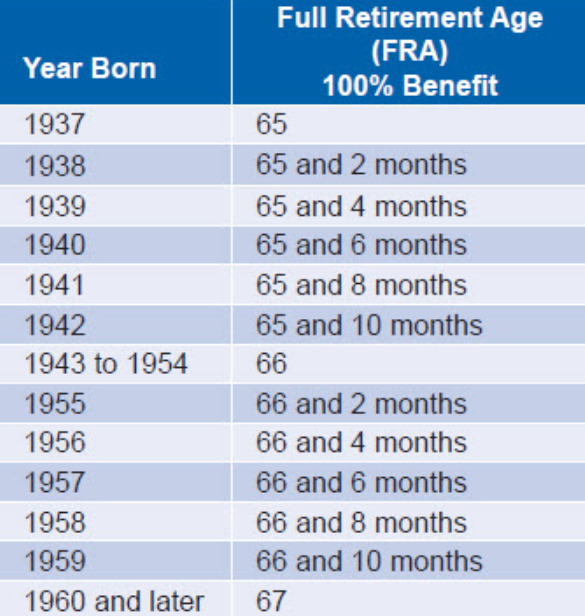
I mentioned that you can collect retirement benefits any time between the ages of 62 and 70, but there is one specific age that the SSA considers your full retirement age (FRA). It is based on your date of birth as laid out in the chart below:
Your FRA is when you are eligible for the PIA I explained above. I know, it’s starting to look like a middle schooler’s text feed with so many acronyms. Would you prefer I write them out?
When you reach your full retirement age you are eligible for your primary insurance amount. But what happens if your full retirement age is 67 and you want to start collecting at age 62? They decrease your benefit amount. The primary insurance amount is decreased by 5/9 of 1% for each month you claim early, up to 36 months. If you claim even earlier, then it is reduced 5/12 of 1% per month. For example, if your full retirement age is 67 and you claim benefits at age 62, your PIA is reduced by 30%.
It works in reverse as well. Your primary insurance amount is increased by 8% for every year you wait to collect benefits after your full retirement age. Only until age 70, though. There is no benefit in waiting any longer.
How To Decide When To Claim Benefits
Things are set up so that whenever you begin collecting benefits, whether age 62, 70, or some time in between, if you live the average life expectancy you will collect the same total amount over your lifetime. The break-even point where it all evens out is around age 82 or 83.
So, is there an optimal time to start collecting retirement benefits?
That will depend on your own unique situation. Often when we do an analysis, it turns out best to wait as long as possible to increase the monthly benefit amount. One of the reasons for that is that when one spouse passes away, the surviving spouse gets to collect the greater of either his or her own benefit or the deceased spouse’s benefit. For that reason, in situations where one spouse’s earned benefit is much higher than the other’s (as is usually the case for a pastor who has opted out of Social Security but has an eligible spouse), it is often best for the higher-earning spouse to wait to maximize their benefit.
Another thing to take into consideration is your health and family history. If you have health problems or a family history of shorter lifespans, you may be better off collecting benefits sooner.
What is best for you? I wouldn’t know for sure unless I looked at your exact numbers and even then, I have no way of knowing when God will call you home. None of us do, so you just have to make the best decision possible with the information that you do have.
The 4 Most Important Retirement Planning Decisions Ministers Need to Make
This is a guest post by Chris Cagle, author of RetirementStewardship.com and The Minister’s Retirement book. I recently published a book review on his book and it got such a good reception that I asked him to write something specifically for you.
In my book, The Minister’s Retirement, I address many of the fundamental questions that pastors have about planning for, and living in, retirement. Wise planning involves making decisions consistent with biblical stewardship principles and implemented using wisdom and practical knowledge gained through experience. I call this “retirement stewardship.”
Some decisions are more critical than others, so in this article, I discuss the ones I consider of greatest importance based on the extent to which they can help a pastor to “retire with dignity.”
1. The Social Security Decision
Although Christians have mixed opinions about it, Social Security is an expression of God’s common grace. It can be a blessing to Christians and non-Christians alike, especially those with limited savings and no other sources of retirement income.
For most U.S. workers, participation in Social Security is mandatory (which is objectionable to some). You can think of it as a type of public insurance that the federal government administers. It provides specific benefits to regular retirees and those who are survivors, disabled, or indigent. At its inception in the 1930s, Congress intended it to be a safety net for the neediest seniors and other vulnerable groups, not a “be all” retirement plan for the retired masses.
Social Security now provides about a third of the income for older retirees, and over half need it for more than 50% of their retirement income. That means that a large segment of the retired population would be in big financial trouble in retirement without it. Therefore, deciding whether to participate in the program and, eventually, when to start receiving benefits if they do, is one of the most critical ministers will make.
As defined by the IRS, a minister can decide not to participate in the Social Security program. If they opt-out and don’t contribute, they won’t be eligible for specific Social Security health and retirement benefits when they retire. That means they will have to find alternatives for retirement income, disability insurance, and paying for Medicare insurance.
Opting-out can’t be a purely financial decision (in order to avoid Self-Employment Contribution Act (SECA) taxes). According to the IRS, it has to be on religious grounds. In such cases, the church might consider giving the pastor an additional “allowance” for a portion of the 15.3 percent SECA tax. The pastor could use that to boost his retirement savings or to purchase a deferred income annuity or cash-value life insurance product to help fund his retirement, as he can’t directly apply it to the SECA tax.
Social Security is a good source of retirement income—it functions much like a lifetime inflation-adjusted income annuity. If they participate, some pastors’ benefits upon retirement will be their only source of income, making the opt-out decision of utmost importance.
2. The Retirement Saving Decision
You’ve heard this drumbeat over and over: “Save as much as you can now for retirement because Americans are living longer than ever and your chances of running out of money are greater than ever.” Well, this isn’t just a catchy phrase; it’s a plea to everyone to save enough so that they can “retire with dignity.” The younger you are, the greater your opportunity to get this right. You only have one shot at it!
That’s why a pastor should start saving for retirement as early as possible, preferably in a 403(b)-retirement plan if one is available. Ideally, he would save at least enough to get the church’s matching contribution, which might be 3 to 6 percent of his salary. Saving early starts up the compounding engine of long-term growth, enabling savings to grow exponentially.
A distinct advantage of the 403(b) is that the church automatically makes the pastor’s deposit from his salary. Along with its matching contribution of some percentage (typically in addition to his salary), it directly deposits them into the pastor’s retirement account. Contribution amounts deposited are exempt from the self-employment tax and federal income tax, and the distributions are eligible for the housing allowance at retirement.
The Roth IRA is also a very popular retirement savings vehicle. Nonetheless, pastors should only use it only in certain situations as no part can be claimed as a housing allowance in retirement. A pastor without access to a church- or denomination-sponsored retirement plan or who is maximizing their 403(b) contributions and wants to use one to set aside more savings in a separate account is a good candidate for the Roth IRA.
3. The Investing Decision
Saving consistently over a long time carries more weight in future outcomes than whether you invest in fund X or Y or hold 60 percent in stocks or 70 percent. But that doesn’t mean that a pastor’s investment choices don’t matter. It’s possible to take too much risk or too little. He may have sufficiently diversified his investments between stocks, bonds, and alternatives relative to his stage of life and risk tolerance.
Some people’s strategy for investing is to “play the markets.” They buy and sell and try to time market ups and downs to make a profit. Although there is the occasional success story, this has been proven to be a losing strategy in the vast majority of cases.
Here’s the reality: the stock market is us—all of us—we are the market. So, it’s actually a little foolish for the average person to believe that they, or even a competent paid adviser, can “beat the market.” Mr. Market is the sum of all the feelings, sentiments, beliefs, and behaviors of everyone who invests in the market—many who are much more knowledgeable and experienced than you or I. So, apart from the nominal economic growth that we all benefit from, you’ve got to beat somebody else at the same game and by more than what it costs you to come out ahead. And that someone could be a very knowledgeable and experienced Wall Street hedge fund manager running a multi-million-dollar portfolio.
My point is that it really doesn’t make sense to go toe-to-toe with the professionals on Wall Street, especially when we’re talking about the money that you will need to live on in retirement. You’ll be much better off owning a cheaply-managed basket containing many different stocks—a “mutual fund.” I like index funds as they virtually ensure that, at a minimum, you’ll capture your portion of the economic growth of whatever sectors you’re investing in at a relatively low cost. If you want to pay more for “well-run” mutual funds, be my guest, but keep in mind that less than 20 percent of them will actually do better than the indexes.
A pastor can invest in a 403(b) using the same vehicles as any qualified or non-qualified retirement accounts (stocks, bonds, and alternatives). I strongly suggest no-load mutual funds and ETFs with low management fees. Passively managed index funds have become very popular with investors, as have retirement target-date funds. A pastor can read up on and study this topic and make their own choices, but they may have better things to do with their time (praying, studying, preaching, evangelizing, counseling, etc.).
Here is where an experienced financial planner/advisor can help. However, pastors should be wary of commission-based stock and insurance brokers and choose a fee-only planner or advisor they trust. They should also be very cautious about investing with a financial professional in their congregation; it can quickly become sensitive. If the pastor’s not happy or wants to make a change, relational difficulties can easily arise. That said, seeking wise counsel from someone in the church—perhaps the church business manager or stewardship deacon or pastor—is always a good idea. They may offer some high-level suggestions and point you to a reputable professional.
4. The Home Purchase Decision
For many retirees, including pastors, home equity will be an “ace in the hole.”
For those reasons and others, most pastors should try to purchase a home and take full advantage of the tax benefits of homeownership. Churches have mostly gotten out of the parsonage business, so it’s beneficial to pastors and their families for several reasons. They can build their net worth by paying down principal and with market appreciation. Plus, the federal income tax law provides generous benefits to the pastor who is buying a home. Income taxes can be reduced and perhaps eliminated because of the housing allowance and additional deductions for mortgage interest and real estate taxes.
The goal is to have a paid-for house at retirement, thereby reducing housing expenses and making home equity available in retirement if needed. Home equity often becomes a large part of a retiree’s total net worth. They can tap it for income in various ways—equity line of credit, second mortgage, or reverse mortgage. That said, most financial professionals suggest using it only as a last resort.
God is on his throne
A pastor who makes wise decisions in these four areas and, most importantly, follows biblical principles of financial stewardship day in and day out will be doing what he can to put himself and his family on solid financial footing before and during retirement. God is on his throne, so the rest is up to Him.
The Different Kinds Of Income A Pastor Can Have & How The IRS Treats Them
This post breaks down all of the major types of income a pastor can earn and explains how the IRS treats them for Social Security, income tax, retirement plan and payroll tax purposes. It is based on IRS Publication 517.