All Posts By Amy

Why All The Hate Against Dave Ramsey & Is There Any Truth In It?

by

This post is based on Dave Ramsey’s Financial Peace University and not his radio show. As such, it may not address everything that he has ever said publicly.

Dave Ramsey is a polarizing figure. Honestly, though, anyone who dares to be different and open their mouth about it is. Donald Trump. Alexandria Ocasio-Cortez. Jesus. (I had to end on a positive note since one of those other names probably got a rise out of you.)

Just like other polarizing figures, Dave Ramsey has throngs of loyal followers and many who actively hate him. That’s to be expected. Today we’re going to take a deeper look at the opposition. Why do people hate Dave Ramsey and is there any merit in their allegations?

What Normal People Have Against Dave Ramsey

He Is Convicting & Not Always Nice

A lot of normal, everyday people don’t like Dave Ramsey. Why? Because he is not afraid to call people stupid and he advocates for a lifestyle where personal pleasure is subjected to personal responsibility. That doesn’t sound like fun, does it?

We live in a hedonistic society where the concept of personal responsibility is slowly evaporating. That is very gratifying for our sinful nature. Think of a 3-year-old. What do they do? Whatever they want without regard for the consequences to themselves or others. We are born this way, so our natural tendency is to want to be this way. 

Dave Ramsey goes against this, so people don’t like it. And he does it in a very confrontational way that can sound arrogant and insulting, which only serves to further irk people. It makes sense that people don’t like him when he brings conviction and tells them to act in a way contrary to their natural tendencies. But is Dave Ramsey wrong? You can argue his methods, but in the end, his ideas are right. I say he’s right because the Bible also tells us that we are to crucify our sinful desires, put others first, and be wise stewards of our finances.  

He Doesn’t Like Debt

Dave Ramsey makes it abundantly clear that he hates debt and some people hate him for it. They say that his ideas are impossible and no one can live without debt, in fact, that society couldn’t even function without debt.

I would ask, why are you such a fan of debt? Why do you feel the need to defend it so vehemently? Take a minute to reflect on that. Debt makes instantaneous gratification possible. So it has a lot of fans. Because we all just want what we want when we want it. Remember our sin nature discussion above?

What about the idea that life is impossible without debt? Even Dave Ramsey acknowledges that some things are very hard without debt. That’s why he doesn’t yell at people for having a mortgage and instead teaches people to do it responsibly. The dissenters get a point here, but it doesn’t count as a point against Dave Ramsey because he agrees.

Another debt that a lot of people say you can’t live without is student loans, which Dave Ramsey is not willing to be flexible on. I would have to side with Dave Ramsey on this one. I’ve earned four college degrees without a cent of debt and never had a college fund (though I didn’t study anywhere prestigious or have time/money to party, either). It is possible to get a college education without debt. However, unlike Dave Ramsey, I would not yell at someone for taking out debt to pursue a degree that is a direct pathway to a career that generates enough income to pay off the loans quickly. Here I’m talking about things like engineering, not seminary. I believe in education and I believe in seminary, but I don’t believe most entry-level pastors earn enough to be able to pay off student debt. 

He Is Rich

Dave Ramsey is rich. He’s not rich because of illegal activities or an inheritance, but because he offered the world something that people found valuable enough to pay for. Many, many people. And then he managed that money that he earned wisely. 

I know it’s popular to hate the rich these days, but if you hate someone because they are rich (or beautiful, or smart, or whatever attribute you are envious of), that is a personal issue that has nothing to do with them. You have a heart issue.

There is nothing wrong with being rich. The Bible doesn’t say that there is anything wrong with being rich. It says that being rich can be very dangerous, but that doesn’t make it wrong. In fact, wealth was often a way that God blessed people in the Bible, a sign of his favor. He didn’t commit any crimes to get that way, so there’s nothing inherently wrong about Dave Ramsey being rich. 

What Financial Advisors Have Against Dave Ramsey

While many financial professionals agree with a lot of the complaints outlined above, there are a few points of contention unique to the financial services industry. Most of those, though, can be explained by their perspective and the regulations they are subject to. 

You see, if you are a financial advisor in the eyes of the law, you are subject to A LOT of regulations. There are so many things that you must do or can’t do that wouldn’t even make sense to an outside person. For example, I work for a registered investment advisor, and even though I’m not an advisor yet myself, I am not allowed to contribute more than $150 to a political candidate that I can’t vote for ($350 if I can vote for them) and I have to report to my boss about contributions I make to any political candidates. 

You see, while Dave Ramsey provides financial advice by most people’s definition of the term, he is very careful not to cross the line to where he would have to register as a financial advisor and be subject to all of the accompanying regulations. For financial advisors who have to bend over backward to comply with regulations to protect their livelihoods, that can be incredibly frustrating. 

He Gives Blanket Recommendations

A major complaint that financial advisors have is that Dave Ramsey gives blanket recommendations, meaning he applies the same advice to everyone without personalizing it. Legally, that is an unethical business practice for financial advisors. However, that is what Dave Ramsey’s business is

While a financial advisor’s job is providing personalized advice to optimize an individual’s financial situation, as a media producer, Dave Ramsey’s job is the opposite. He seeks to provide a framework that is generic enough that anyone could apply it to their situation and his ultimate goal is behavior change, not financial optimization. If you look at what he is doing as if he were a registered financial advisor, it is terrible. But he’s not a registered financial advisor and he isn’t trying to be one (though I’ll bet he has a good team of legal counsel helping him get as close as possible without crossing the line).

It’s a lot like what I do here at Pastor’s Wallet. I provide financial education and generic advice for pastors. But I am not acting as a financial advisor. If one of my readers needs a financial advisor because they want personalized advice, I refer them to Guide Financial Planning where I work. Guide is registered with the state and also has state-registered financial planners on staff, so Guide can provide services that Pastor’s Wallet cannot. 

Dave Ramsey sometimes provides more personalized advice on his call-in radio show. I have not listened recently enough to comment on that.

He Talks About 12% Returns

Probably the most popular reason to hate Dave Ramsey among those who are financially literate is his penchant to discuss 12% stock market returns (though I’ve also seen 11% more recently). Boy, do people like to crucify him for that. From a regulatory perspective, a financial advisor could get into big trouble for making claims about 12% returns. However, as I said, Dave Ramsey is not a registered financial advisor so, as he says, it’s his show and he can use whatever numbers he wants. 

Are 12% returns realistic, though? One challenge is that there are different ways to calculate stock market returns, so you can get different answers with the same data. Then, if you take into consideration inflation, taxes, and things like that, your numbers will change again. If you google “stock market historical return,” you will find that most results reference the S&P 500, which is a proxy for the US stock market as a whole, and the results will range from 10-11%. 

Is that 12%? No. One point for the frustrated financial advisors! Is his use of 12% a problem? As a financial professional, I would never promise someone a 12% return and I would never use that number when doing projections. It would be irresponsible. However, I’m okay with him using it.

While that may sound hypocritical, let me explain. What is Dave Ramsey’s goal? To get people to spend less than they make and save money for the future. It is not to predict the likelihood of an individual having enough money to survive a long retirement as a financial advisor does. 

If you walk over to your local park right now, you might find some kids playing little league baseball. If you get close enough, you may hear the coaches and parents talking. There’s a good chance someone will mention making it to the Major Leagues and playing professionally. Now, are you going to butt in and tell those irresponsible adults that the probability of those children going pro is next to nothing and what they are saying is akin to child abuse? No! Many children dream of becoming professional athletes and the adults in their lives use those dreams to motivate them to make an effort. As they mature, it is expected that they will have a more realistic understanding of their skills and adjust their expectations accordingly.

Dave Ramsey is like those parents and coaches. He uses a number that makes compound interest graphs look interesting to motivate people to action. And, like the aging athletes, as people grow in their financial literacy and savings, they usually seek professional help where they get personalized projections with more realistic numbers.

Is a 12% return realistic? Probably not (I acknowledge that there are investments that generate those returns, but in general, most people’s entire portfolio will not), but I think the way Dave Ramsey uses it still does much more good than harm.   

He Recommends Commissioned Salesmen & Actively Managed Investments

Dave Ramsey does not outright recommend working with a commissioned salesman for your investments, but he has SmartVestor Pros that he endorses that include them. The SmartVestor Pro program is a referral program where a financial advisor pays a fee in exchange for being recommended on the Ramsey website. Dave Ramsey’s company vets these advisors, though I do not know what standards they use other than that he says “they have the heart of a teacher.”  

Personally, I do not trust the conflicts of interest inherent in the commission-based model for advice. That is why, for my own career, I have chosen the fee-only route. However, I know there are some trustworthy people that work for commissions, so I cannot give a blanket condemnation of all advisors who use that business model. 

Dave Ramsey also promotes actively managed mutual funds, though he doesn’t speak against passive index funds. Actively managed funds are more expensive and the majority underperform when taking fees into account. However, some do beat the market. This argument is much like the fee-only versus commissions argument. While they may not be the best investments, I cannot in good conscience make a blanket statement saying that they are all bad. You can’t make a solid argument that Dave Ramsey is completely wrong in this area, but if going this route, I would definitely say to proceed with caution.  

How To Have A Healthy Perspective Of Dave Ramsey

As with many polarizing figures, I believe that many people have an unhealthy perspective of Dave Ramsey on both ends of the spectrum, just as much those who love him as those who hate him. Usually, it comes down to the person and their perspective and is not really an issue with Dave Ramsey himself. Here is what I think is a healthy way to view Dave Ramsey and what he preaches.

He Is Not Giving Personalized Advice

The first thing to remember is that he is not giving personalized advice. He is giving general advice that is not specifically situated for any one person’s situation. As a pastor, you probably preach on Sundays and do counseling as well. Are they the same?

No, preaching and counseling are not the same because one is personalized and the other is not. When you preach, you write a message that can apply broadly to your listening audience based on principles. When you provide counseling, you tailor your advice to the specific person you are talking to. Dave Ramsey preaches, he is not counseling. Financial planners are the counselors. 

He Is Providing A Framework

Dave Ramsey provides a framework for personal financial management designed to meet the needs of the most people possible. It’s like tract homes. You know, those neighborhoods where every single house looks exactly the same except maybe the garage is on alternating sides. They are designed to efficiently meet the needs of the general populace. If you’re looking for a 3 bedroom, 2 bathroom home with a kitchen and living room to meet your family’s needs, you’ll be happy in a tract home. However, if you want your dream home, you’ll probably be disappointed. In the same way, if you want Dave Ramsey’s program to perfectly optimize your personal financial situation, you’ll be disappointed. He’s only providing a framework.

He Is Not God

We’ve come to my final point and this one is for everyone who loves Dave Ramsey. He is not God. And to his credit, he’s never claimed to be. Personally, I think the most dangerous thing about Dave Ramsey for most people is not talking about 12% investment returns, but the pharisaical, militant blind obedience of some of his followers.

I am a part of a Facebook group for Financial Peace University coordinators (yes, I help teach his classes) and some of what I see in there is very concerning. There are constantly people giving adamant advice on things they don’t understand that have potentially serious consequences. It’s dangerous. Just because you’ve heard Dave Ramsey address a topic once or twice does not mean you are qualified to dispense advice on the issue. It would be like me insisting on how you should care for your diabetic child just because I know diabetics need insulin and lack of it can be fatal. Because of my limited knowledge of diabetes, that’s an area where I would likely do more harm than good if I tried to give advice. 

I see a lot of people giving harmful advice based on one or two things that Dave Ramsey either said or didn’t say. Just because he told one caller something doesn’t mean it’s right for every single other American. And just because he hasn’t addressed something doesn’t mean it has no merit or is flat out wrong. Dave Ramsey is not God and his words are not the one-and-only source of all wisdom. (If he were here, he’d probably refer you to his wife on that one.)

How Do You View Dave Ramsey?

As I said in the beginning, this can be a very polarizing topic. If this rubs you the wrong way because you’re a faithful Dave Ramsey devotee, let me ask you: How many people have you talked to about Dave Ramsey and his way this year? How many people have you talked to about Jesus and his way this year? What does that say about your true passion?

Dave Ramsey is human just like the rest of us. He is neither God nor the antichrist. His program does not perfectly optimize every person’s financial situation, but it has helped a lot of people improve their lives in many ways. If you are a Dave Ramsey-lover, I would encourage you to remember who your true savior is and where the ultimate source of truth is. If you’re a Dave Ramsey-hater, I would encourage you to go and read Matthew 7:5. That’s all, folks. 

0

Are Pastors Eligible for the Home Office Tax Deduction?

by

Like many all over the globe, pastors did a lot of work from home last year. Whether you already had a dedicated space or had to claim a corner of the dining room table, last year was the year of the home office. Does that mean you get to claim a home office deduction on your taxes?

I’m sorry to say, probably not. Some strict requirements must be met in order to claim the home office tax deduction, and the majority of pastors likely will not qualify. 

Requirements to Claim the Home Office Tax Deduction

Self-Employed vs. Employee

The first rule, which knocks out almost everyone, is that employees cannot claim the home office tax deduction. Even if all of your work is always done from a home office. If you are an employee of a church or other organization, you cannot claim the deduction (even though you pay some taxes as if self-employed). The home office tax deduction is only available to the self-employed who file Schedule C (and some partners, but that doesn’t apply here). 

Exclusive Use

In addition to being self-employed, you must use the office exclusively for business purposes. “Business” is the term that the IRS uses, but if you’re a pastor, you can substitute “ministry” and it means the same thing. Exclusive means that nothing else can go on in that home office. One hundred percent of the time that it is being used, it has to be used for business purposes.

This is the rule that knocks me out of the running. I am self-employed and have a home office. However, my kids love to read next to the heater in my office and I use my desk and computer in the office for personal things and to teach Financial Peace University classes through my church. Because we use my office for things other than my work, I cannot claim the home office deduction. 

Regular Use

You also must use your office regularly. Even if it is set aside exclusively for your work as a pastor, if you only occasionally use the office, it does not qualify. Now, there isn’t a concrete line drawn between the “regular” and “occasional” use of an office that I can refer you to. The IRS would look at all of the facts and circumstances in making a determination. It isn’t usually a problem, though, because it’s usually one of the other requirements where people fall short, such as exclusive use. 

Principal Place of Business

Finally, the home office must be your principal place of business. If you have an office in a church or something similar, then even if you regularly use your home office exclusively for ministry, it likely will not qualify. The home office must be the principal place of business. Of course, if you go elsewhere to perform wedding ceremonies and the like, that shouldn’t be a problem. You can perform ministerial services in other places, as long as your home office is your main office.

How to Calculate the Home Office Tax Deduction

Let’s say you’ve met all of the requirements. Maybe you do traveling ministry and work out of your home office that isn’t used for anything else. How do you actually claim the home office tax deduction?

The home office deduction is subtracted from your self-employment income on Schedule C. You can use the deduction to reduce your income down to $0, but it cannot create a loss (negative income). 

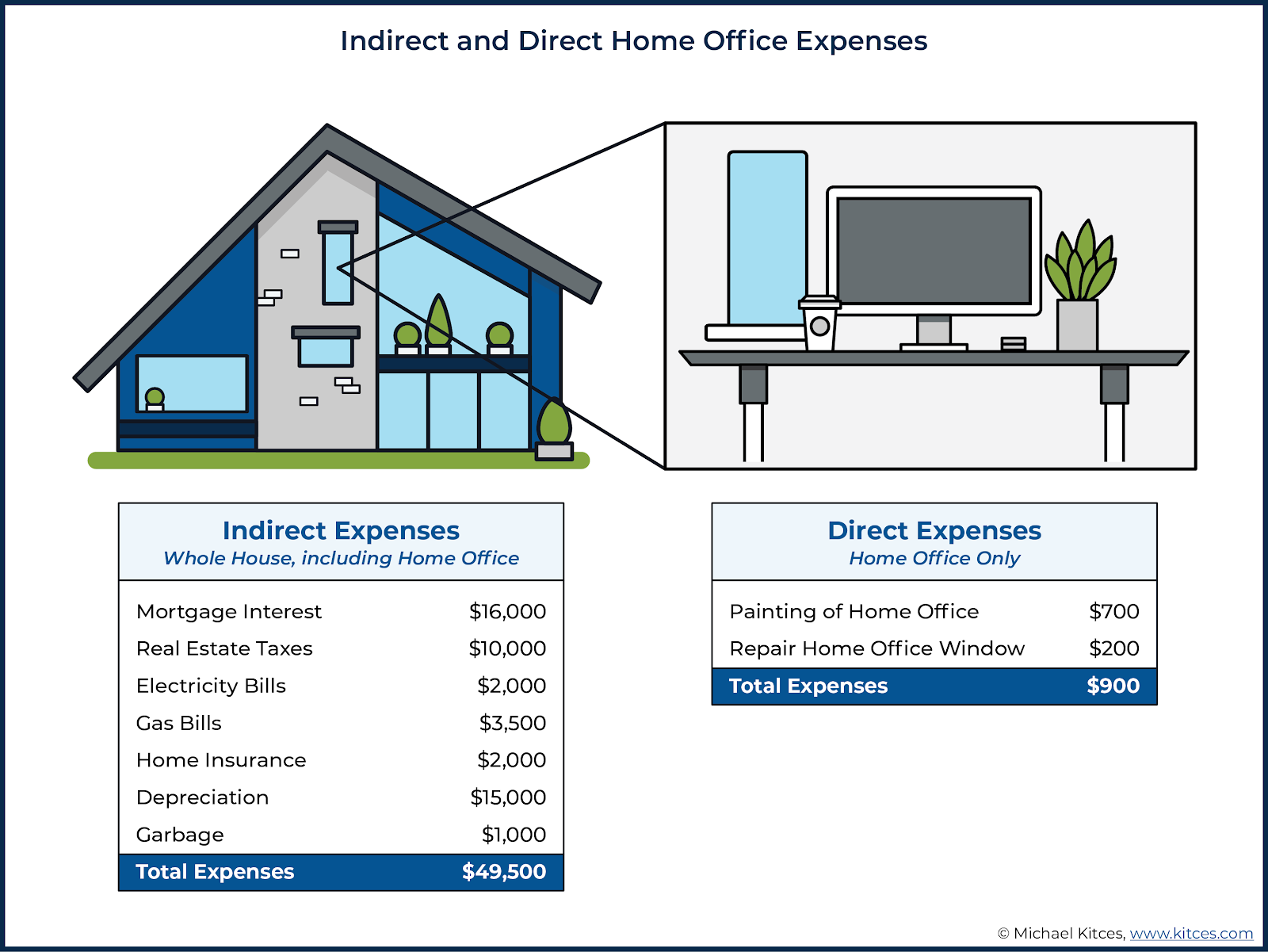
There are two methods of calculating the actual deduction, the Regular Method and the Simplified Method. With the Regular Method, you divide expenses between direct and indirect expenses. Direct expenses are those that only apply to your home office, like installing blinds so you look better on Zoom. Indirect expenses are shared with the rest of the home, like electricity and mortgage payments. This graphic from financial planner Michael Kitces illustrates the difference well.

All of the direct expenses are included in the home office deduction and a proportion of the indirect expenses are included. You can calculate indirect expenses as a percentage of the home’s square footage or some other reasonable comparison. One important thing to note is that you must depreciate your home when you use this method, which can affect the taxation whenever you sell it. 

If that sounds too complicated, then the Simplified Method is for you! And it really does live up to its name. Just take the square footage of your home office (but only up to 300 square feet) and multiply it by $5. There you have it, that’s your deduction. Simple, isn’t it?

How the Home Office Deduction Affects the Housing Allowance

This is an article for pastors wanting to claim the home office deduction, so we have to address the clergy housing allowance. Does claiming a home office deduction affect your housing allowance? Yes, it does. 

The housing allowance provides you with a tax exemption for creating a home, not a business. As such, business use of your home is excluded. You don’t lose the entire housing allowance, just a proportional amount related to the business use of your home. This article explains it in more detail including how to do the calculations. Basically, you can’t double-dip. You can’t get tax-free housing and then deduct the expenses on your tax return again. 

I’m sorry if you were planning on claiming a home office deduction this year and I dashed your hopes. Look on the bright side, though. You probably saved a lot of money on gas!

0

When Should A Pastor Request A Housing Allowance?

by

Any time you want tax-free housing!

While that answer is true, here is an excerpt from my book, The Pastor’s Wallet Complete Guide to the Clergy Housing Allowance, that will provide a bit more depth: 

Timing

Timing is very important when it comes to the housing allowance. A housing allowance can only be paid prospectively, not retroactively. That means you cannot go back in time. You can only take a housing allowance after it has been designated; any expenses incurred prior to the official designation are ineligible.

That is why leaving the designation open-ended is a good idea. Then you don’t have to worry about missing out on the housing allowance because you forgot to get it officially designated on time. You know you will always have it available to you and you only need to worry about the amount rather than the timing.

Many churches designate housing allowances by the calendar year since that is how most pastors file their taxes. If that is how your church does it, you should make sure to request your allowance in December of the prior year so that there is time for it to be officially designated before the start of the new year. 

Nonetheless, you can actually request a housing allowance at any time during the calendar year. The IRS has no restrictions on timing other than requiring the designation to be provided in advance of payment. So, if you enter the ministry or change churches in August, you should request your housing allowance immediately instead of waiting until the next January.

Changing Your Housing Allowance

Also, you can change your housing allowance at any time. If your housing situation changes dramatically mid-year, you can request a new housing allowance designation that will reflect that. For example, you purchase a home in June after having lived in a cheap apartment. You should request a higher housing allowance at the end of May in preparation for your move. 

The higher housing allowance amount would only apply to your expenses in June and thereafter. All of your housing costs up until the new designation would still only qualify for the lower, previous designated allowance. In this kind of situation, you would have to calculate your housing expenses for the two separate time periods, January through May and June through December. If you found at the end of the year that you had excess housing allowance from the second half of the year, you would not be able to use it for expenses from the first half of the year. 

Backdating A Housing Allowance

Sometimes, a church will fail to designate a housing allowance in a timely manner and they may want to backdate a resolution or pass one retroactively to allow a pastor to have previous expenses covered. That is illegal. Wrong. Bad. Not allowed. A SIN!

Knowing falsification of such a document is a crime under the Sarbanes-Oxley Act. There is no exemption for churches and pastors under the act and penalties range from fines to imprisonment. Aside from the Sarbanes-Oxley Act, such behavior is subject to civil or criminal penalties under the tax code. Just don’t go there. Pay the taxes and learn your lesson for next time.

If you want to learn more about the clergy housing allowance, pick up a copy of The Pastor’s Wallet Complete Guide to the Clergy Housing Allowance on Amazon today!

Purchase The Complete Guide to the Clergy Housing Allowance by Amy Artiga
0

I Just Passed The CERTIFIED FINANCIAL PLANNER™ Exam & Why I Did It

by

About seven years ago, I decided I wanted to be able to help people with money. I had begun listening to Dave Ramsey to stave off the boredom of spending 12 hours a day alone with an infant and it was life-changing. I didn’t know much about money because my parents didn’t know much. All I knew was to work hard and save because eventually you always need money. 

I also knew that finances have a profound impact on your life and your relationships. My mom was a single parent with six kids in southern California, so I had experienced firsthand the levels of stress and anxiety that can come from financial struggles. In listening to Dave Ramsey, I realized that helping someone get control of their finances can change their life, their marriage, their family, and their future for generations to come. I wanted to do that.

Two Avenues For Financial Advice

I began to research and discovered that there are basically two ways to provide people with one-on-one financial advice: as a financial coach or a financial advisor. They share a lot of similarities, but financial coaching is basically unregulated while financial advisors are subject to a lot of regulations because they work with investments and manage money for people. I’m really more interested in the people than the money, so I thought I would become a financial coach. After all, it would be a lot easier to get started without having to jump through hoops for regulators.    

There was one problem, though. To discuss investments, you have to be registered as a financial advisor. While I didn’t want to manage investments, I felt that I wouldn’t be able to serve people adequately without being able to discuss investments. They are kind of an important part of personal finance, even if they aren’t your focus. So, I resigned myself to the fact that I would have to become a registered financial advisor and take on all of the regulatory burdens that come with it. 

Now, this wasn’t a path I was heading down because I needed to make money, but rather because I wanted to help people. Regular, everyday people like my friends and family, who wouldn’t normally be able to afford personalized advice from an expert. I decided that I wanted to develop a level of expertise that I could charge $500/hour for, but offer it to people who could only dream of being able to pay that much. 

What Is The CERTIFIED FINANCIAL PLANNER™ Designation?

In the financial advisory space, the CERTIFIED FINANCIAL PLANNER™ designation is the gold standard. There are numerous designations and certifications available, but the hardest and most respected is the CFP® designation, so that’s what I set my sights on. It was a pretty ambitious goal for a stay-at-home mom with no financial services experience. 

Education

There are four requirements for certification. The first is education, which consists of seven college-level financial courses. To fulfill that, I enrolled in the University of Alabama’s Family Financial Planning and Counseling program as soon as both of my kids were in school full-time. Little did I know that they would be coming home full-time halfway through the program. In spite of it all, I completed my Master’s in December 2020 (and am now officially a homeschool mom to boot!). 

Examination

The second requirement is an examination. You have to understand, this isn’t just a test like the final exams you took in college. This is a big, scary test. In 2019, only 62% of the people who took the test passed. They have to limit the number of times you can take it (5) because some people take it multiple times without being able to pass. It’s that hard.

Why? There are two reasons. First, it covers a ton of material (7 classes, remember?). Second, the question writers aim for the top of Bloom’s taxonomy. That means knowing the material and how to apply it is not enough, you have to be able to evaluate and analyze the information, which makes it seem very subjective. I know very intelligent people who have failed this test.

I studied hard for months and up until recently, passing felt absolutely impossible. 

But on Friday, March 12, 2021, I passed on my first attempt. YAY!!!

Experience

Passing the exam is a big accomplishment, but it’s not enough for me to be able to call myself a CERTIFIED FINANCIAL PLANNER™ certificant. I need to have real-life experience as well. The requirement is either a 2-year apprenticeship doing financial planning under another CFP® professional or three years doing related work. I’ve already been at it for two years now, but it will still be several more years before I fulfill the experience requirement because I only work part-time (remember those two kids at home with me?). I’ll get there, though, because I love the team that I’m working with over at Guide Financial Planning.

Ethics

The final requirement is a commitment to a very high ethical standard and submission to a thorough background check. I think this one will be easy since Jesus has been my role model for a number of decades now. My background check will be pretty boring for them since I haven’t had a run-in with the law since I was 19 and curious to see how fast my car could go on an open, empty stretch of highway somewhere between San Diego and Sacramento. 

This is an important requirement, though, because most people place the financial industry right down at the ethical bottom along with used car salesmen and Congress. I came across a statistic recently that 65% of people don’t trust the financial services industry to do what’s in the best interest of their clients. I want to help change that statistic and while I would ascribe to high ethics no matter what, I appreciate that the CFP® designation values and requires it.  


What’s Next For Me

Does passing the exam make me a financial advisor? No. Because I haven’t met the experience requirement yet, there are a few more (much easier) hoops that I have to jump through in order to be registered as a financial advisor and legally able to provide financial advice for a fee. That’s next on my list and I’ll get it done soon. Until then, I will continue to build my expertise and serve you through this blog. 

This has been a long, hard journey and more than once I have been asked or asked myself, Why are you doing this? It’s not like I have to go through this much trouble just to register as a financial advisor and it’s not like I need it to support my family. However, I have a strong conviction of the Lord’s direction for my life and if I’m going to do this, I’m going to do it with excellence. Whenever I start to doubt, I receive emails from my readers that remind me that I’m on the right path. This has been exhausting, but it is all worth it. Because YOU are worth it. 

0

How Everyone Can Deduct Charitable Contributions In 2020 & 2021

by

A lot is said about the tax-deductibility of charitable contributions. After all, that is why your church went through the trouble of gaining 501(c)(3) status with the IRS. So that donors could get tax breaks.

Not everyone gets a tax break for their charitable giving, though. It all depends on how you file your taxes. 

Itemizing for Charitable Deductions

Usually, in order to get a deduction for your giving, you have to do something called itemizing deductions. It means that you list out all of the different things you are eligible to deduct and add them up. You have to fill out an additional tax form and track your giving, state and local taxes, medical expenses, and things like that. The other option is to take a standard deduction, which is a lot easier.

For 2020, the standard deduction for a single person is $12,400, for a head of household it is $18,650, and for a married couple it is $24,800. That means that as a married couple, if your state and local taxes, donations, etc. don’t add up to at least $24,800, you would take the standard deduction instead of itemizing deductions. And when you take the standard deduction, you get no tax benefits for your charitable giving.

2020 Charitable Deductions Under the CARES Act

Until 2020 and the CARES Act. The CARES Act that was passed in March at the start of the coronavirus pandemic allows for a $300 above-the-line charitable deduction for 2020. Above-the-line simply means that it is taken off before the regular standard deduction. That means that people who choose the standard deduction instead of itemizing deductions can get a tax benefit for their giving. Below is a picture of Form 1040 showing where to take the deduction.


What about if you itemize your deductions? Can you still take the special CARES Act deduction? No. Because you’re already taking it on Schedule A when you itemize. This provision doesn’t punish you in any way, it just helps out those who claim the standard deduction. 

Charitable Deductions in 2021

The CARES Act provision was only for the 2020 tax year. In December, another stimulus bill was passed that contains the same provision for 2021 and even makes it better. You see, the 2020 $300 deduction is always $300, whether you file as a single person or as a married couple. The deduction for the 2021 tax year removes the “marriage penalty” and allows a $600 deduction for joint filers.

To summarize, on your 2020 tax return, you can deduct up to $300 in charitable contributions, regardless of your filing status, even if you claim the standard deduction. And on your 2021 tax return, single filers will be able to deduct up to $300 in the same way and married filers will be able to deduct up to $600. That’s great news, especially now that 86% of people are claiming the standard deduction!

0

How Pastors Can Claim The Earned Income Tax Credit

by

Every year, the federal government hands out money for free. However, one out of five people who are eligible doesn’t claim it

That sounds crazy, right? Who foregoes free money? And how can you be eligible to get it?

For all you know, you might be one of the crazy ones. This free money I’m talking about comes in the form of the Earned Income Tax Credit (EITC). In 2020, the government handed out $57 billion in EITC alone. That means there was $14.25 billion last year up for grabs and some of it could have been yours.

What Is The Earned Income Tax Credit?

The EITC is the government’s attempt to offset some of the payroll taxes for lower-income workers. Everyone pays payroll taxes at a flat rate (more or less). It is not a progressive system like income taxes where those with more earnings pay a larger percentage of their income. To make things more progressive and lighten the load on those that don’t make as much, they created the Earned Income Tax Credit

The EITC is a refundable credit. That means first it is used to offset your income tax bill. If you’ve taken your tax liability down to $0 without using up all of the EITC, then the IRS will cut you a check for the remainder. Pretty nice, huh?  

How Does The Housing Allowance Affect The Earned Income Tax Credit?

The EITC is based on income, which is rather straightforward for most people. But not pastors. Does the housing allowance count as income or not? The answer to that question flips back and forth depending on the government program or tax benefit that you’re referring to. In this case, the answer is both yes and no. Like I said, not very straightforward.

If you have opted out of Social Security with Form 4361 or Form 4029, then your housing allowance DOES NOT count as income for purposes of calculating the Earned Income Tax Credit. If you’re exempt from self-employment taxes, then your housing allowance is exempt from counting towards the EITC. When you do still participate in the Social Security system, then your housing allowance DOES count as income for the EITC. It is part of your net self-employment income.

No Social Security = No Housing Allowance

Yes Social Security = Include Housing Allowance

How To Claim The Earned Income Tax Credit

If 20% of the people eligible for this refundable tax credit don’t claim it, how do you know if you’re one of them? The IRS has a nifty calculator, called the EITC Assistant, to help you. You’ll need to input your income, so make sure you are including/not including your housing allowance per the guidelines above. 

The first step in claiming the tax credit is filing a tax return. Even if you don’t owe any taxes, you will need to file a return in order to claim the credit. If you file your own taxes, make sure to follow the IRS instructions for calculating the EITC carefully. Here is a handy list that they’ve published of errors to watch out for. The EITC is a part of the regular Form 1040 tax return, so you will see it come up as you fill out your forms. When using tax preparation software, make sure that things are calculated correctly, because not all software is programmed properly for the minister’s housing allowance!

After reading this, you may be thinking about previous years’ returns and wondering if you missed out on some money. Worry not! You can claim the EITC for prior years by filing an amended return. This IRS page has all of the information you need in order to do it.

If you are looking for a tax preparer, there is a list of reader-recommended professionals at the end of this article.

0

Who Is Responsible For The Clergy Housing Allowance: The Pastor Or The Church?

by
Purchase The Complete Guide to the Clergy Housing Allowance by Amy Artiga

This is an excerpt from my book, The Pastor’s Wallet Complete Guide to the Clergy Housing Allowance

Pastor Housing Allowance Responsibilities

Pastor, when it comes to the housing allowance, you’re the man (or woman). If you want the tax savings that the clergy housing allowance provides, it’s on you. It’s not the church’s responsibility, it’s yours. You are the one who has to calculate your anticipated expenses for the year, submit them to your church, and make sure they approve it in time.

Also, it’s your job to track your expenses throughout the year to substantiate the housing allowance that you claim. Unlike an accountable reimbursement plan where you have to submit receipts to the church, hang onto your receipts. If you get audited by the IRS, you are the one that will have to answer to them, not your church. 

Church Housing Allowance Responsibilities

The church or denomination is responsible for officially designating the housing allowance before paying it. Until the official designation has been made, all payments count as taxable income. To make it official, the church must put it in writing as a part of an employment contract, in the church’s budget, in meeting minutes, in a church resolution, or “in any other appropriate instrument evidencing such official action.” (Treasury Regulation § 1.107-1(b)) The designation must simply identify a payment as a housing allowance as opposed to salary or other remuneration (pay).

Once the church has made the official designation, their only responsibility is to pay the housing allowance and record it properly. The allowance should be paid along with the minister’s regular wages, but the amount is not included with wages on Form W-2. In fact, the church does not report the housing allowance to the IRS at all. If it’s on the W-2 as wages, it’s taxable, so make sure your church does it right. That’s why you need to be extra nice to whoever does your church’s payroll. If you get on their bad side, it could cost you big time.

At the end of the year, the church needs to let the pastor know the total housing allowance for the year and it is the pastor’s responsibility to report that to the IRS on Schedule SE. If the pastor is exempt from self-employment taxes, then the housing allowance is never reported to the IRS at all. Isn’t that nice?

How To Report The Housing Allowance 

To inform the pastor of the housing allowance amount, the church may include it in an official letter or show it on Form W-2 in box 14. Box 14 is an informational box only, so employers have some flexibility in how they use it. The church can report the pastor’s housing allowance by writing something like “Housing: 20,000” in that box. The housing allowance should never be included with wages in Box 1. (If it is, have your church fix it and send you an amended Form W-2.)

Breakdown Of Responsibilities

Here is a breakdown of how the housing allowance works:

  1. Pastor calculates anticipated housing expenses for the coming year.
  2. Pastor requests housing allowance from the church.
  3. Church makes an official housing allowance designation.
  4. Church pays pastor housing allowance.
  5. Pastor tracks housing expenses throughout the year.
  6. Church informs pastor at the end of the year of how much was paid in housing allowance.
  7. Pastor files tax return, reporting housing allowance on Schedule SE (unless you have opted out, which is discussed later) and including excess housing allowance as taxable income on Form 1040.

This process should be repeated annually. If you have pretty steady housing expenses, you can request the church to designate your housing allowance in an open-ended manner. An example would be, “First Church designates a housing allowance of $25,000 a year for Pastor John. This designation shall be effective for the current year and all subsequent years unless otherwise provided.” That way, you don’t have to go through the process of requesting the housing allowance every year. Instead, you can skip steps 1-3 and only go back to them when your housing expenses change. Steps 4-7 must still be followed every single year, though. 

Even if you use open-ended wording, you should still calculate your housing allowance on a regular basis. Housing costs creep up gradually and if you’re not careful, you’ll end up paying taxes on a significant portion of your income unnecessarily. You can find sample housing allowance designations, worksheets to help you calculate your housing expenses, and an online calculator at pastorswallet.com/free-resources

If you want to learn more about the clergy housing allowance, pick up a copy of The Pastor’s Wallet Complete Guide to the Clergy Housing Allowance on Amazon today!

Purchase The Complete Guide to the Clergy Housing Allowance by Amy Artiga
0

How The New Coronavirus Stimulus Bill Affects Pastors

by

After keeping the nation on its toes for a week, President Trump signed a new stimulus bill into law on December 27, 2020. The stimulus bill was actually only a small part of the 5,000+ page Consolidated Appropriations Act of 2021 that funds the government until September. In addition to the stimulus bill, there were also some tax law changes tacked on to it as well. While you probably already know about the stimulus checks it authorized (and the political battle being waged over their amount), there are also other aspects of the bill that might affect you and you should be aware of. While none of it is pastor-specific (your housing allowance is still safe!), these are the parts that may impact you:

Stimulus Checks

Everyone’s favorite part is a new round of stimulus checks to be mailed out immediately. Though similar to the checks sent out this spring, there are still some important differences. First of all, the checks are worth $600 per eligible person. Eligible people are individual taxpayers and children that are eligible for the Child Tax Credit, namely those under age 17. This time kids and adults are worth the same amount of money, though some teenage dependents are still left out. 

Again, there is a phaseout so that higher-earners don’t get anything. The phaseout starts at $75,000 for individual tax filers, $112,500 for heads of household, and $150,000 for married, joint filers. Once you hit that amount of adjusted gross income (AGI), you will lose $5 of stimulus money for each $100 of income you have. For example, a single person with an AGI of $80,000 is $5,000 over the limit. As such, their stimulus check is reduced by $250 ($5,000/$100 *$5) and they only get $350 ($600-$250). If that person had two qualifying children, their benefit would be $1,550 ($600*3 people – $250 reduction).

The federal government wants to get these checks into people’s hands as quickly as possible, so they are calculating them based on the 2019 tax return income information that they already have. Nevertheless, these are technically tax credits for 2020 taxes. Thus, even if you don’t receive one because your 2019 income is too high, if it is lower in 2020 you can get the credit when you file your taxes. If things are the other way around, where you are eligible based on 2019 income but not 2020, you’ll still get the check in the mail and not be expected to pay it back. And, as before, these checks are not considered taxable income so nothing will be withheld (whether you tithe on it is between you and God!). 

Unemployment Benefits

What made this legislation so time-sensitive for many individuals is the fact that their unemployment benefits were set to run out this week. Under normal circumstances, you can only receive unemployment benefits for 26 weeks. The government wants to motivate you to find a job and get back into the workforce. However, that’s hard when the government itself has shut everything down and there are no jobs to be had. The CARES Act addressed that by extending unemployment benefits to 39 weeks. The current legislation tacks on another 11 weeks, pushing the expiration date out to mid-March for those whose benefits almost disappeared this week. 

Another 11-week extension of the CARES Act benefits relates to the Pandemic Unemployment Assistance program. That program allows those who normally would not be eligible for unemployment benefits—contract workers, part-time workers, self-employed individuals, etc.—to receive benefits. If that’s you, you’ll be able to keep receiving benefits from that program through the end of March.

Extra unemployment payments are going to continue for another 11 weeks as well. These are the weekly payments above and beyond the normal unemployment amounts. Usually, unemployment only covers half of a person’s lost income. They want to incentivize people to get back into the workforce as quickly as possible. Since 2020 was anything but normal, the federal government augmented regular benefits first with $600 a week and then only $300 a week. That $300 a week extra payment will continue for 11 more weeks.

The last CARES Act unemployment enhancement that is being extended is the elimination of the one-week waiting period. Customarily, when you lose a job you have to wait a week before you can collect benefits. Now, if you get laid off today you will be able to start receiving benefits tomorrow. This, too, will last 11 more weeks.  

Flexible Spending Accounts

If you don’t have a flexible spending account (FSA), go ahead and skip this section. If you do, you’re in luck. As you know, FSAs are use-it-or-lose-it accounts. All of the money in them needs to be spent by the end of the year (some offer a 2 ½ month grace period or allow a $500 rollover) or it is forfeited. You usually select a contribution amount at the beginning of the year based on your planned expenses for the year. But 2020 didn’t exactly go as planned, did it?

Many people planned for summer camps that never happened, non-urgent medical care that was postponed, or childcare that was no longer needed when one parent ended up unemployed at home. The money that was supposed to pay for those things is still sitting in FSAs. Congress thought it wouldn’t be fair for so many people to lose their money at year-end because the pandemic turned the world upside down. 

The new bill permits employers to allow people to roll over 2020 funds into 2021 and 2021 funds into 2022. They can also adopt a grace period of up to 12 months for using the funds in 2021 and 2022. The key to all of this, though, is that these changes are not automatic. The employer has to choose to enact these changes. So, if you have an FSA, ask your church or HR department of your secular employer if they are going to give you some grace. If they haven’t already decided to do so, go ahead and nag them until they do. Within reason, of course. 

Required Minimum Distributions

If you haven’t reached your 70s yet, go ahead and skip this section. If you have, you’re probably familiar with required minimum distributions (RMDs). They are the amount you are required to withdraw from your retirement accounts (except Roth IRAs) each year so the government doesn’t have to keep waiting on the related taxes. This spring’s CARES Act waived RMDs for 2020 so that no one was required to take withdrawals. That provision was NOT extended with this new bill, so you will have to take your RMD again in 2021.

Student Loan Relief

Another CARES Act benefit that is going away is the student loan relief. Federal student loan interest and payments and collections on defaulted student loans have been suspended since March. That is only going to last until the end of January 31, 2021. At that point, you will have to continue to make any student loan payments you owe. Interest will begin accruing again as well. 

Charitable Contribution Deductions

Not all of the CARES Act benefits are going away. The above-the-line charitable deduction for those who take the standard deduction will continue into 2021 and even get better. For the 2020 tax year, up to $300 of charitable donations (such as your tithe) can be deducted per tax return, whether you file as a single or couple. For 2021, singles will still be able to deduct $300 and married couples will be able to deduct $600. It isn’t huge, since a $300 deduction when you’re in the 12% tax bracket only amounts to $36 saved. Every little bit counts, though.

Tax Credit Eligibility

There are some refundable tax credits that are based on earned income (Earned Income Tax Credit & Additional Child Tax Credit). Pastors always have to pay particular attention to these because of the way that the housing allowance decreases your earned income. There are situations where it’s actually more beneficial to limit your housing allowance in order to maximize these credits. 

Because so many people were unable to earn income during 2020, the new stimulus bill allows taxpayers to use either 2019 or 2020 earned income numbers when calculating the tax credits on their 2020 tax return. This is a nice benefit. That way you can calculate it both ways and use whichever numbers maximize the tax credits for you. 

This is only a small piece of the 5,593 pages of legislation that the President signed. It represents the provisions most likely to affect you as an individual. The bill also extended the Paycheck Protection Program, which you should look up if you think your church could benefit from it. For more information on the new stimulus bill from a financial planning perspective, this is a really good article to read.

0

The Top 10 Personal Finance Blog Posts For Pastors Of 2020

by

We’ve made it to the end of 2020. For the last blog post of every year, I provide a list of the top ten posts that have received the most views during the year. It gives you a chance to catch up on anything important that you may have missed during the year and it gives me the chance to slack off and write an easy post over the holidays. It’s a win-win, don’t you think?

Combined, these posts have been viewed around 60,000 times this year. What is everyone so interested in? Here they are in order of popularity: (Each title is linked to the article, so you can read them.)

1. Secular Jobs For Pastors: 9 In-Demand Skills You Already Have

This article was in the top spot last year as well and ranked #3 in 2018. I think it has become even more important this year as high unemployment rates and decreased giving have caused many pastors to look outside the church for income.

The post describes the different skills that most pastors have and how they can be communicated in a way that the secular world will understand (and appreciate!). The truth is that you already have a lot of highly-marketable skills, you just need to know how to translate them into secular vernacular. This is particularly helpful if you are looking to create a resume for a secular position. If that’s you, make sure to check out our article on writing a relevant resume as well.

2. Clergy Housing Allowance Calculator

This isn’t actually a blog post, but it’s the second most popular page on Pastor’s Wallet so I thought I should include it. It is a simple, interactive calculator that you can use to calculate your housing costs. It’s not overly sophisticated because I built it myself (contact me if you have skills in this area and want to make the site better!), but it provides you with an estimate of your annual eligible housing costs and a recommended amount to request based on adding a 10% buffer for unexpected expenses. If you haven’t checked it out, go ahead and try it for 2021!

3. How Much Housing Allowance Can A Pastor Claim?

This is a big question and I get a lot of emails asking me different versions of it. The housing allowance is one of the greatest financial benefits available to pastors, so it makes sense that you would want to maximize it. This article goes through the legal limitations on the housing allowance, how to apply the law to your particular situation, and some things to consider before actually requesting your housing allowance. If you aren’t already a housing allowance pro, this one is a must-read.

4. How To Calculate Fair Market Rental Value For The Clergy Housing Allowance

It isn’t any wonder that this article comes in right after the last since many people probably click over and read it from the last article. One thing you would read about how much housing allowance you can claim is that it is limited to the fair market rental value of the furnished home. That, of course, begs the question, How do you calculate fair market rental value? I wrote this article to answer that for you. 

5. 2020 Housing Allowance For Pastors: What You Need To Know

By now you’ve probably noticed a theme… housing allowance. It’s a popular topic on this blog. This article covers some important things for you to know about the housing allowance, including how it could affect your eligibility for the child tax credit, how it is affected by a home-based business, how to change it mid-year, and even how to claim one in retirement. The article also includes a free downloadable housing allowance worksheet in both .pdf and .xlsx formats. 

6. Do Pastors Pay Social Security And Medicare?

Now we move away from the housing allowance to another important topic, Social Security and Medicare taxes. This is a really important one for pastors because many don’t realize that their employer doesn’t withhold these taxes for them. Pastors are supposed to pay them themselves. If you don’t know that, though, you don’t pay them and if you don’t pay your taxes you can get into big trouble. Thus, this is an important article if you don’t already know how Social Security and Medicare taxes work for pastors (and that it’s different than for everyone else). 

7. Business Ideas For Pastors That Want To Make Extra Money

Back to making more money. Because we all know that the ministry doesn’t always pay the bills. This article goes through 15 different side gigs that you could use to supplement your income (or even turn into a full-time job or business). The best part is that they are all flexible enough to work around your ministry instead of competing with it. 

8. Why Don’t Churches Pay Payroll Taxes For Ministers?

This is another important topic, closely related to #6. It may not be the most exciting, but it is crucial for you to understand if you’re a pastor. Churches don’t pay payroll taxes for ministers. They can’t. This article explains how payroll taxes work and, most importantly, what happens if a church does try to help a pastor out with their payroll taxes. This is the kind of stuff that you really need to know.

9. Health Insurance For Pastors: What Are Your Options?

Despite all of the attention it has gotten over the last decade, health insurance is still a problem for many pastors. Most larger denominations offer group health insurance, but there are still a lot of pastors and churches left trying to figure everything out on their own. This article goes through all of the different options available for individuals, from the Obamacare marketplace to health sharing ministries to Medicaid and more. It also discusses options for churches that want to help out, even if they can’t afford to offer traditional group health insurance. There are a lot of options out there and this article walks you through each one.

10. Are Pastors Eligible For The 20% Qualified Business Income Deduction?

Rounding out the top ten for 2020 is the 20% qualified business income deduction. This is new to the tax code, created with the Tax Cuts & Jobs Act of 2017. It allows for a 20% deduction for Schedule C income to effectively lower tax rates for non-corporate businesses. They did this to make things more fair after slashing the corporate tax rate. Most pastors don’t see themselves as businesses, but some still have Schedule C income that is eligible for the deduction. The article explains what pastoral income is eligible and how to claim the deduction.

That’s it, the top ten for 2020. I know this has been a challenging year for most, so I want to thank you for your ministry and plagiarize the Apostle Paul with this prayer for you:

May the God of hope fill you with all joy and peace as you trust in him, so that you may overflow with hope by the power of the Holy Spirit. 

Romans 15:13 (NIV)

0